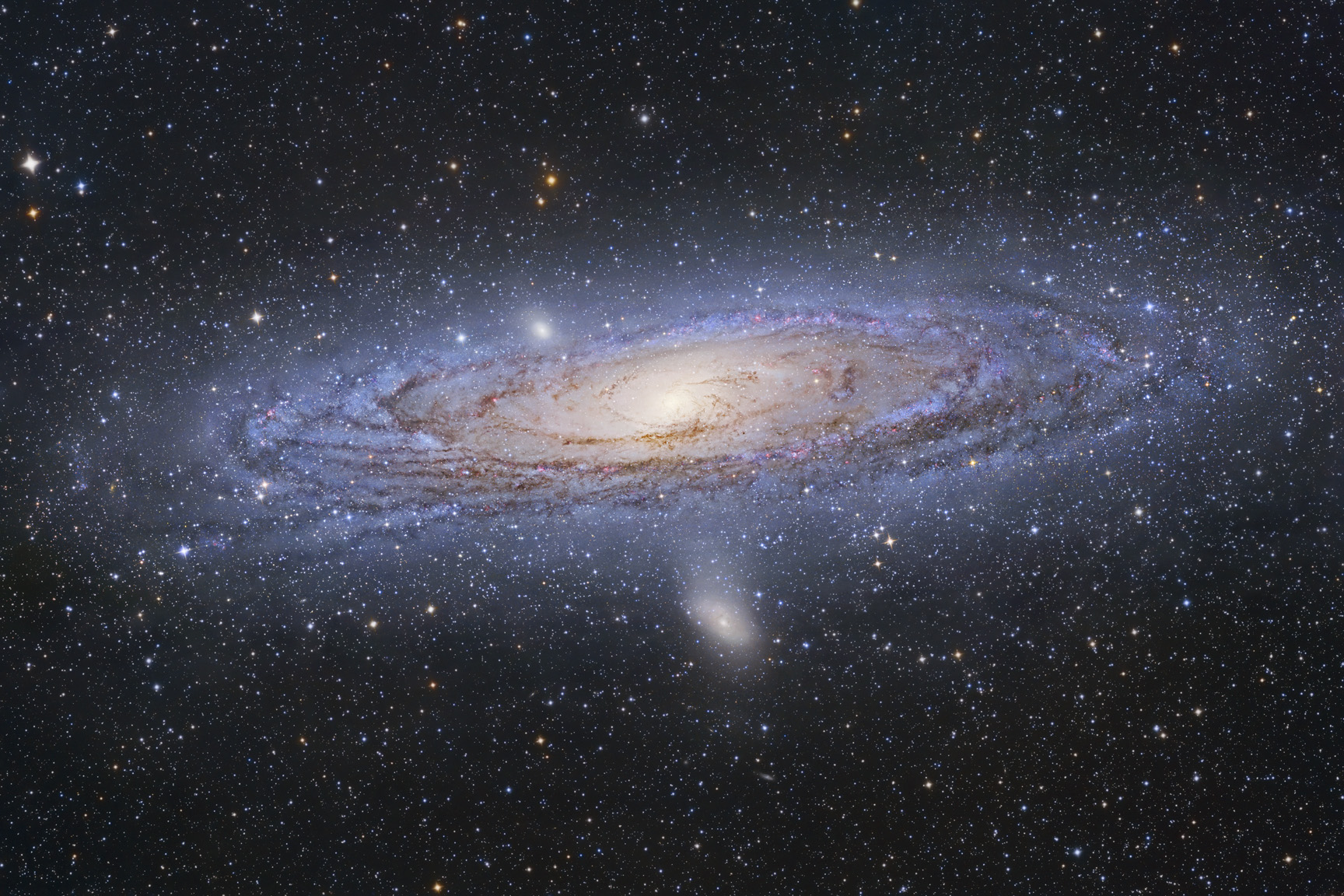
This is the immense Andromeda Galaxy, also known as M31.
So what's in a name?
We haven't always known that the Andromeda Galaxy was, in fact, a galaxy. But for all of recorded history, that fuzzy patch of light
has been sitting within the constellation of Andromeda. Constellations are not just mere patterns of stars or shapes in the sky; they are well defined regions of the sky, just like states and provinces are well defined regions within a country. When we say something is in a constellation, we aren't just referring to the stars that outline a constellation's familiar shape. Instead, we mean everything within that patch of sky. The Andromeda Galaxy, although much more distant that the other objects which make up the constellation of Andromeda, is still within (behind) the stars in that patch of sky. Hence the name Andromeda.
But what about M31, what the heck does that mean?
In the 18th century, the French astronomer Charles Messier was compiling his list of Messier Objects, which he turned into a book,
Nebulae and Star Clusters, published in 1774. The first edition of this book did not list all of the Messier Objects - Messier identified 110 deep sky phenomenon, this book listed only 45 of these.
Messier couldn't tell exactly what all of these objects were. Even with the telescopes of the age, we couldn't detect detail anywhere close to what we can today. It turns out that some of these Messier Objects, which Messier might have thought to be nebulae or small star clusters (and indeed, some of them were), were in fact supernova remnants, and immense swirling galaxies, millions of light-years away. The Andromeda Galaxy is one of those objects. In fact, it is the 31st object in
Messier's catalogue. Hence the Andromeda Galaxy's other name, M31.
Original picture source
here.